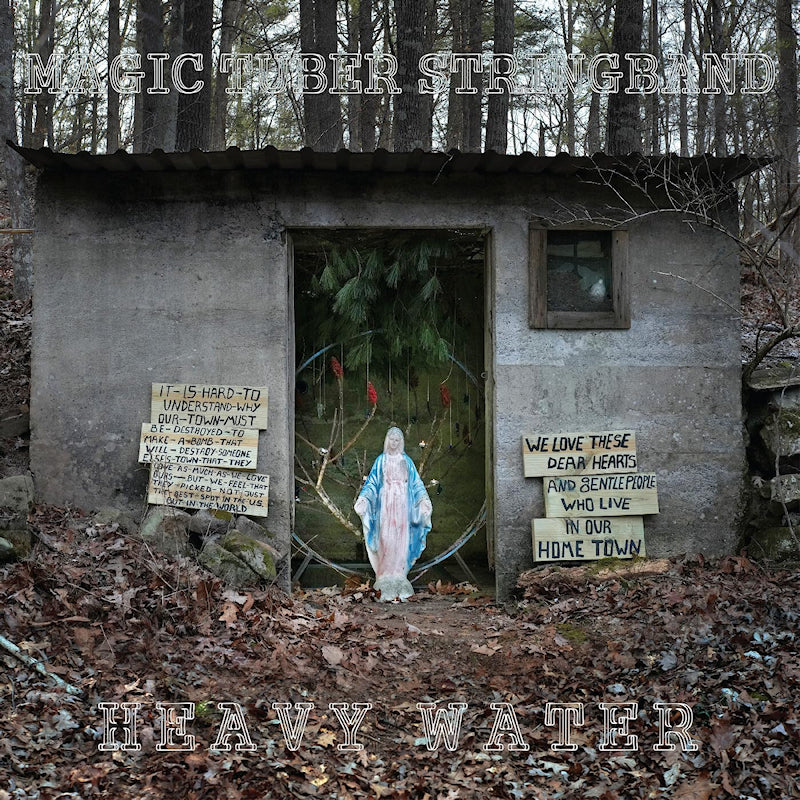
Magic Tuber Stringband - Heavy Water (Opaque Turquoise Vinyl LP)
In 2023, Evan and I moved to the town of Aiken, South Carolina so that I could start an ecological research project on the Savannah River Site (SRS), a former production facility for U.S. nuclear weapons materials. A year beforehand, I had been browsing wildlife-related jobs from home in Durham, NC and had come across a call for a graduate student at the University of Georgia’s Savannah River Ecology Lab, located within the boundaries of the SRS. According to the posting, the student would be funded to study whether songbirds inhabiting the SRS were radioactive due to contaminant transfer from leaked nuclear waste. I applied without hesitation and was quickly accepted—I’ll never know whether for my own merit or for a scarcity of applicants looking to spend two years on a nuclear waste site.
The highway into the SRS from Aiken goes through the small town of New Ellenton, SC, cheerfully nicknamed “Atomic City”. New Ellenton carries the namesake of Ellenton, the largest of the towns displaced for the construction of the SRS in 1951. A few years prior, the U.S. had escalated its Cold War posturing and begun coordinating the mass production of thermonuclear hydrogen bombs (H-bombs). The U.S. Atomic Energy Commission contracted the corporate giant DuPont to lead the construction and operation of a new nuclear materials plant. DuPont surveyed candidate sites across the U.S., aiming for someplace rural with a mild climate, an abundant water supply, and an exploitable labor pool. Five days after Thanksgiving in 1950, a radio broadcast announced the selection of a 310 square mile piece of land along the Savannah River in South Carolina.
Original: $46.45
-65%$46.45
$16.26Magic Tuber Stringband - Heavy Water (Opaque Turquoise Vinyl LP)
In 2023, Evan and I moved to the town of Aiken, South Carolina so that I could start an ecological research project on the Savannah River Site (SRS), a former production facility for U.S. nuclear weapons materials. A year beforehand, I had been browsing wildlife-related jobs from home in Durham, NC and had come across a call for a graduate student at the University of Georgia’s Savannah River Ecology Lab, located within the boundaries of the SRS. According to the posting, the student would be funded to study whether songbirds inhabiting the SRS were radioactive due to contaminant transfer from leaked nuclear waste. I applied without hesitation and was quickly accepted—I’ll never know whether for my own merit or for a scarcity of applicants looking to spend two years on a nuclear waste site.
The highway into the SRS from Aiken goes through the small town of New Ellenton, SC, cheerfully nicknamed “Atomic City”. New Ellenton carries the namesake of Ellenton, the largest of the towns displaced for the construction of the SRS in 1951. A few years prior, the U.S. had escalated its Cold War posturing and begun coordinating the mass production of thermonuclear hydrogen bombs (H-bombs). The U.S. Atomic Energy Commission contracted the corporate giant DuPont to lead the construction and operation of a new nuclear materials plant. DuPont surveyed candidate sites across the U.S., aiming for someplace rural with a mild climate, an abundant water supply, and an exploitable labor pool. Five days after Thanksgiving in 1950, a radio broadcast announced the selection of a 310 square mile piece of land along the Savannah River in South Carolina.
Product Information
Product Information
Shipping & Returns
Shipping & Returns
Description
In 2023, Evan and I moved to the town of Aiken, South Carolina so that I could start an ecological research project on the Savannah River Site (SRS), a former production facility for U.S. nuclear weapons materials. A year beforehand, I had been browsing wildlife-related jobs from home in Durham, NC and had come across a call for a graduate student at the University of Georgia’s Savannah River Ecology Lab, located within the boundaries of the SRS. According to the posting, the student would be funded to study whether songbirds inhabiting the SRS were radioactive due to contaminant transfer from leaked nuclear waste. I applied without hesitation and was quickly accepted—I’ll never know whether for my own merit or for a scarcity of applicants looking to spend two years on a nuclear waste site.
The highway into the SRS from Aiken goes through the small town of New Ellenton, SC, cheerfully nicknamed “Atomic City”. New Ellenton carries the namesake of Ellenton, the largest of the towns displaced for the construction of the SRS in 1951. A few years prior, the U.S. had escalated its Cold War posturing and begun coordinating the mass production of thermonuclear hydrogen bombs (H-bombs). The U.S. Atomic Energy Commission contracted the corporate giant DuPont to lead the construction and operation of a new nuclear materials plant. DuPont surveyed candidate sites across the U.S., aiming for someplace rural with a mild climate, an abundant water supply, and an exploitable labor pool. Five days after Thanksgiving in 1950, a radio broadcast announced the selection of a 310 square mile piece of land along the Savannah River in South Carolina.